|
THE OLD HOUSE SPEAKS IN 1988
Life without imagination would be dull
and drab, so I ask you to take advantage of your imagination that I, an
“Old House”, am speaking and telling a story of my life (if a house can be
said to have a life). It is also the
true story of the Campbell family since they came to America.
I am still standing on the site,
which a fourth generation Campbell and his wife selected to make their
home. In this direct line was
Robert, born in County Down, Ireland; his son Alexander, born in Prince
Edward County, Virginia; his son Hamilton Crockett, born in 1786 in
probably what was Virginia at the time and is now Tennessee. He settled in what is the village of
Campbellsville, Giles County Tennessee.
His son Alexander is the builder of my homestead and the line of Campbells who lived within my walls soon after Giles
County was established in the early years of the 1800’s.
Hamilton Crockett built a two-story
log house near a big, ever-flowing spring, which still gives good fresh
water to the people around the community.
This house is still standing but was recently purchased out of the
family ownership, along with several other farms, by Cuban investors.
The first Campbell of which we have
a record is Robert, who landed in Philadelphia around 1725 as a boy
seven-years-old then drifted southward through Virginia or South
Carolina. He and his wife seemed to
be of Scottish Presbyterian stock from Ireland. His wife’s name was Leticia. This name was mentioned in the record of
several families in early days. It
was not mentioned, however, in recent times until one of Robert Campbell’s
sons, Gillis, and his wife, Martha Dimmock
Campbell, named their first child Leticia.
Martha, daughter of Al and “Chick” Dimmock,
and Gillis were very good dear friends of Donald and Wessie
Campbell through the years since he served as pastor of the Presbyterian
Church in Pulaski.
The first Hamilton Crockett fought
in the War of 1812 and was in the famous battle of Great Horseshoe Bend in
Alabama. He married Mary Mitchell
Dickey after settling in what is Campbellsville Giles County,
Tennessee. She was said to have been
a woman of remarkable beauty and superior intelligence. She died at the age
of 89 and left 79 living descendants.
They were the parents of the second
Alexander who married Margaret McErwin Thompson. Not much is known about her before he
marriage save that she lived in the vicinity near where Reelfoot
Lake was formed in West Tennessee and the fact that her mother, Mrs.
Matilda Henderson, is buried in the northwest corner of the community
cemetery at Campbellsville. Many of
the first Campbells are buried at the family
cemetery behind the house that Hamilton Crockett built. A deed and right of way to this cemetery
is recorded in the Giles County Courthouse.
The present family of the homestead takes care of this cemetery.
Alexander and Margaret selected me
as their home site beside a big spring, which was a necessity in those
days, and built their first home.
They has six children: 1)
Mary Matilda, married Frank Kimbrough of Weakley Creek, 2) Margaret Ann,
married Frank’s brother, Jim of Weakly, 3) Martha Caroline, married John
Clinton Hannah of Campbellsville who became county official, 4) Crockett,
Alexander’s son, happened to meet Forest when she stopped there one day on
her way home from visiting a friend and there began a friendship which led
to marriage, 5) Laura Etta did not marry early and lived with Crockett and
Forest until she married Markus West.
They had one child Malcolm Campbell, who lived in Columbia,
Tennessee until 1988 and died there. 6) Robert Newton, the younger boy
became a Presbyterian preacher. He
married Belle Covey and they had four children. He contracted Tuberculosis and died a few
hours before his son Robert was born in 1903. Alexander died at an early age resulting
probably from a blow to the head which he received from a man accused of
stealing a hog from a neighbor.
Alexander was trying to help get the hog back for the owner. After his death Margaret’s house burned
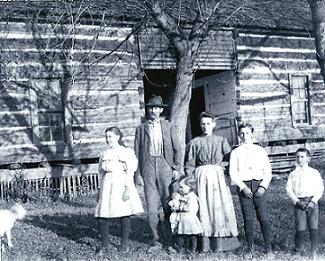
and she was left with six children and no house. I, (this house) was probably put up at a
“Log Rolling”, a big event of a neighborhood in which a log house was put
up sometimes in one day by neighbor men, while their wives cooked a big
dinner in the middle of the day.
This was a useful custom for pioneers. Trees for the logs were plentiful and the
houses strong. The houses were
usually, as this one was, two big rooms with a half story above and an open
hall between the rooms, open at each end for storage of wood, work area,
cool sitting room, etc. This was
known as a “Dog Trot” through which the dogs would run and bark hoping for
food from the table at meal time.
Those eating would toss bread to them saying “Hush Puppy”, thus came
the origin of a popular food in the South today, a corn meal cake of bread
served with fish or chicken.
Margaret’s house was noted as most homes then were, for hospitality
and as the custom was the widowed Mother made her home with the child who
kept the home place after the father’s death. Crockett, who began helping support the
family by farming at age eleven, kept the house with his wife, Forest, and
took care of his Mother. Nothing is
reported of any conflicts between the new daughter-in-law
when she came into the home. The
three age groups had never heard of the custom or term “Generation
Gap.” Crockett felt the influence of
his Mother’s teaching, and his and Forest’s home became one of the homes in
the church’s custom of entertaining the preachers by inviting them to spend
Saturday night before holding services on Sunday. They always had discussion on the Bible
issues and called on the preacher to have a prayer with the host family
before leaving. Usually the prayers
went on and on (it seemed to the children).
On one occasion like that, Donald and Grace, now almost grown, were
the only children at home. For some
reason, probably citing some chores to be done managed to stay out of the
parlor where the discussions were taking place. They decided they would both sneak off to
bed and escape the long prayer and they did so but when time for the prayer
came and trick was discovered, what happened? Each name was called and each had to get
dressed and come and sit for the prayer just the same. They should have been ashamed for such
conduct. I’m afraid this isn’t practiced
now days but more family praying would make better families today.
Margaret raised her children in the
strict Presbyterian custom of working six days of the week and resting on
the Sabbath Day, but with the entire family attending church and friends
going home with someone to eat a big dinner. This was not a very restful day for the
women but as much as could be, was prepared on Saturday. The only cooling system was in the cool
water of the spring house, a shelter over the spring in which they kept
buckets of food sitting over night.
Sitting under a shade tree and talking was the Sunday afternoon
entertainment. Even children did not
play loud and rowdy games on Sunday.
It was said the Margaret’s son who became a preacher wanted to play
with his little wagon one Sunday and was told not to do that, he replied
that he would play under the house where God couldn’t see him. (I do not remember what Margaret’s
reaction was.) The houses were built
with a space underneath so that a cellar for storing food was dug out and
there was room enough to walk or play under the house.
Crockett and Forest lived all their
married life in the “Old House” caring for Margaret as long as she lived,
as was the custom before the idea of nursing homes occurred. They had six
children, the first one Albert Clinton, died when he was a small baby,
Burney Walker was born in 1893, then Ann Elizabeth was born two years
later, Donald Andrew was born two years later. Almanza about two years
later but died when she was two or three years old, then in 1903 Grace
Crockett was born. They grew up enjoying life together, each helping with
the work of the home, and going to the two-teacher school. Burney and
Elizabeth went to boarding school in Lynnville, Tennessee. This was called
the Robert E. Jones School and consolidated into being Richland High School
today along with Campbellsville and other small schools nearby with school
buses. Children used to walk to school, the father coming in the wagon
after the children when a snow caught them at school, then some rode
horses, then went in pony carts or double buggies where
as now it is the custom to have a car for the teenagers and school
buses all over the country side or even across the small town. “I have seen
a lot of changes in my time.”
Burney served in World War 1 from
December 1917 until about spring time 1919 never going overseas but
guarding German prisoners who had been captured in Germany and shipped
overseas to America to get them out of the way. This was the first break in
my close family. Many of my family members never traveled to Nashville in
earlier days. Now I watch over the hills seeing my folks fly overhead but
always coming back to my peaceful hills. Well, the old ones chatter on and
on and I must get back to my account of the people you will remember and
trace the line of modern Campbells.
Crockett and Forest’s son returned
from his far away camp at Columbia, South Carolina and even as far as
Jacksonville, Florida to Camp Johnston. We study the pictures Burney sent
back of the marvelous cities, palm trees, alligators and ocean, dreaming of
someday seeing these things and rejoiced when we could once more gather
daily within these walls with our familiar local affairs. Burney married
Virginia Knox and they lived in Lynnville. They had no children, but reared
a cousin whose name was Virginia, and she became their daughter. She and
her husband J.T. Lowery lived with them and cared for them in their old age
with their son, Jim and his son Brad, giving their grandparents joy.
Teaching the boys to fish became their hobbies as well as cooking all good
things for them.
Ann Elizabeth, the next child had
beautiful auburn hair, she had two grandchildren that followed her with
this, Harrell Murrey and Mary Ann Morris
Jefferson. However as they got older their hair color changed. She became
an elementary school teacher and married Turner Orr Morris who taught for a
short time and became a farmer. They bought her father’s farm after their
death for 2,800.00 and moved to my homestead to carry on the tradition.
Their first child William Campbell was two months old when they moved from
his birth-place, Little Dry Creek. He grew up on the farm and spent almost
three years in the U.S. Army stationed in Camp Jackson then in Kaiserslauten, Germany.
Their next child was Jane Elizabeth.
She graduated from Martin College then from the University of Tennessee and
became a County Demonstration agent at Gallatin.
The youngest child, John Newton,
played football for Campbellsville High School, and later went on to play
for the University of Wyoming. He made his home Wyoming.
Donald Andrew was the next child of
the Crockett and Forest and he married Wessie
Eugenia Campbell and they lived in Pulaski where their two daughters grew
up. The first one, Jane Burns, graduate at Rhodes College, then known as
Southwestern, a Presbyterian University at Memphis. She was named as a Phi
Beta Kappa member and became a school teacher just after she married
Charles Gilbert Hosay of Pulaski in 1956. He was
a Baptist minister. They have three boys who were raised mostly in Virginia
and still live there.-Charles Andrew, James Lesley and John Morgan. James
married Jackie Cutchin and they have a girl Lisa
Nicole and a son James Alexander. John Morgan and Andy do work such as city
planning as does their father helping to make a better life for the elderly
or disadvantaged and restoration of old sections of the city. James is in
the U.S. Army Band and serves as an organizer of music and sometimes
directing the band. Andy taught for the University of Virginia and restores
old historic houses.
The younger girl, Mary Don, obtained
her Doctor of Education degree to become Dean of a branch of Home Economics
in Kansas State University at Manhattan, Kansas. She married a native of
that city, Virgil, after going there to teach. They have two daughters,
Mary Virginia (Ginger) who came to Knoxville, Tennessee for her college
education where her mother graduated. She majored in Journalism and now
lives in Kansas City where she works. Her sister Laura Jane (Janie) has an
Associate Veterinary degree and specializes in the health of horses and
trains and rides for her own recreation/ she also lives in Manhattan,
Kansas.
The next Crockett child was Almanza,
who died when about three years of age then the youngest child, Grace
Crockett was born in 1903. She grew up loving school and was very sad when,
due to the poor health of her mother and father, she could not go away from
home to school until there was a High School built in Campbellsville four
years later. Grace returned to school and by being old enough to realize
the value of a good education, she really studied and made good use of
study time which was limited by home chores. She won the honor scholarship
medal and graduated in 1926 in the first high school class. Only six pupils
were enrolled this first year in the senior class.
Now began the effort to go to
college in the fall. With only $100.00 and a lot of determination, the
family sent her to Middle Tennessee State Teachers College in Murfreesboro,
Tennessee for two college quarters then she had to return home to the farm
when her father became very sick. He died in a few months and she obtained
all the rest of her college work and B.S. degree in summer school and wherever
college credits could be gained. Finally in 1942 the degree from Peabody
was realized and extra credits earned with teaching experience, while
working on preparation for teaching she spent spare time observing teachers
with classes at Peabody Demonstration School, a valuable help in ways to
interest and make practical schoolroom methods.
After her fathers
death in 1927, Grace finished out the year teaching at an eighth grade
school at Pigeon Roost, a one teacher school for $55.00 a month an eight
month term, and again the next year, then to Elkton first and second
grades, then progressed to a nine month school and Pulaski Elementary
School in a building used for a hospital during the Civil War. Just prior
to this move, school had been held in the basement of the Massey Boys
School. Teachers were allowed to live in the little upstairs dormitory
rooms of the closed Massey School although cracks were forming in some of
the rooms. Money was not available for teachers to pay rent. She graduated
Peabody College in 1942. After sixteen years in first grade from 1930 to
1946 she transferred to first grade in Winter Garden, Florida near Orlando
and taught there twenty three years, then stayed on in the town after
retirement in this beautiful section of the country until 1981 before
moving back to Pulaski. Forty two years of teaching first grade has offered
many opportunities and pleasures.
After Elizabeth and Turner moved to
this Old House in 1927 there was gaiety and activity with three children
working and playing on the hills and valleys. Much hard work was necessary,
as times in the thirties and forties were lean years with not much spending
money. There were William Campbell, Jane Elizabeth, and John Newton. All
graduates of Campbellsville High School. William Campbell served in the
U.S. Army in Kaiserslauten, Germany part of three
years. We missed him from our halls on two Christmases. He returned in 1955
and married Ruth Nesbitt of Gallatin. They lived in Pulaski and Ruth became
a Licensed Practical Nurse and worked a number of years at Giles County
Hospital.
Elizabeth Turner’s daughter, Jane
Elizabeth, graduated at Martin College then at the University of Tennessee
in Home Economics in Home Demonstration work and became a Home
Demonstration Agent in Sumner Co. Gallatin, Tennessee. She married Harrell
Preston Murrey of Gallatin and they moved to
Russellville, Kentucky where three children were born. Harrell Preston,
Jr. married
Loretta Martin and they are expecting their first child in May 1989.
Harrell is employed at Donnely Printers and
Loretta is a teacher at a local college and working on her doctrine in
English. William Floyd (Bill) married Terri Lessenberry.
They have two children, William Ryan age 6 and Anne Kathryne
age 3. They are employed with a family insurance business. Both boys
married Glasgow, Kentucky girls after they moved from Russellville. Jane
Grace was born next in Russellville and moved to Glasgow when she was
small, and lives there now. She completed her training as a beautician. She
is working part time as a beautician and also works at a local company in
the dietary department. John Morris was born in Glasgow and is enrolled in
his third year in music at Middle Tennessee State University, where he is
training to be a band master.
Jane Elizabeth was an assistant
librarian at the High School in Glasgow until her sudden death of a heart
attack on February 18, 1988.
Elizabeth and Turner’s youngest
child, John Newton born in 1931 grew up on the farm and went to the
University of Wyoming at Laramie and played on the football team for four
years and then in ROTC training.
After graduation, he married Norma Jean Bell, daughter of pioneer
family in the ranching business.
John served in the Army as second Lieutenant at Fort Benning and in Missouri. He then settled on a ranch near Cheyenne,
Wyoming raising cattle and race horses.
Their three girls enjoyed riding and ranch life. Their oldest daughter Betsey married Jack
Graham and with children John Morris, Jamie, and KaLea
(Katheryn Leigh) live in California where she is a homemaker and substitute
teacher. Karen went into television
after winning the title of “Junior Miss America” in 1984, but is now
occupying her time caring for Taylor and Katheryn, identical twin girls
almost a year old and occasionally making commercials for television. She married Curt Gowdy,
Jr., Sports Director for ABC television in New York City. The youngest child Marcy Jo has just
finished a five year college course with a B.A. degree and will teach
Dramatics and Music this fall.
After the death of Elizabeth, Turner
lived alone and life was quiet and lonely.
Turner had always put in his days farming and raising stock and now
had to take on housekeeping also, a chore he did not like or find much time
for. With the help of his
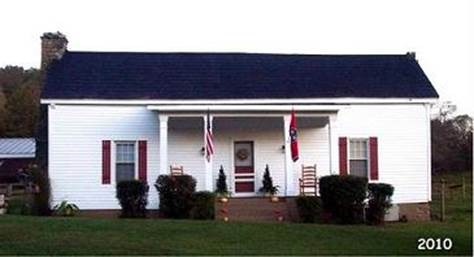
daughter-in-law, Ruth, he got through those years. The farm was bought by William Campbell
and Ruth and after modernizing my still strong sturdy frame the family
moved in in 1976 and I was beautiful and functional on the interior and more
attractive in every way.
Now three different age groups of
friends of the three Morris girls brought fun and interest around.
Deborah Carol went to Martin College
and then continued on to graduate at The University of Alabama in
Huntsville in 1978 with a B.S. in Nursing.
In 1980, she married Donald Eugene Hickerson of Lynnvillle. They have a six year old son Jonathan
Morris and a three year old daughter Jennifer Susann who enjoys riding
ponies and horses and makes the grandfathers enjoy hose shows and riding in
parades.
The next girl, Mary Ann, graduated
from Giles County High School and also attended Martin College and was
cheerleader for their sports. She
married Mark Tague Jefferson of Huntsville,
Alabama and they live there. Mary
Ann is an accountant manager for an advertising agency and real estate
agent.
The youngest girl, Susan Janine
attended High School at Richland School and served through several years of
cheerleading. She graduated from
High School there and married Jeffery English Montgomery of Pulaski in
1986. He is an airman E4 at Hurlburt Field, Fort Walton Beach, Florida. They have a little son Jeffery, Jr. age 2
and return for visits. They are
expecting another child in April 1989.
Susan is a homemaker and works part-time.
I have seen many changes take place
since I first took my stand here early in the 1800 era and my walls are
strong and useful and so are my people.
My hope is that each generation leaves a good heritage of highest ideas
and habits of obedience to God and Country.
I hope they instill in each inhabitant an appreciation of our
blessings in being able to worship and serve God in such a way that those
dwelling in this house will be eternally blessed with a rich heritage.
I’m the oldest Campbell to remember
In 1988 this December.
I want to record who our ancestors were and what they
were like
As men and women and children as well,
Hoping the young ones will tell,
Of our ancestors and homes and where they lived
Part of the story that has gone before
And how dependence on God was still the trend
And still the most important thing that has ever been.
With a great love and enjoyment for all my family,
Aunt Grace
|